
The calm of Thanksgiving morning broke in an instant when a 6 point 0 magnitude earthquake jolted Southcentral Alaska1. One moment the day felt quiet almost slow and the next the ground reminded everyone that the Earth never truly rests2. Homes rattled decorations shook and families getting ready for the holiday stopped mid step trying to understand what had just happened3. The shock ran through the region in more ways than one and it shook the land and stirred emotions4. There was no major damage yet the quake left people wondering why Alaska faces such strong seismic forces and what this sudden reminder of Earth’s power really means for the communities who live there5.
Why Is Earth the Ultimate Exception?

Why Do Earthquakes Happen The Simple Science Explained
Before we go for the simple science behind earthquakes, it helps to remember that our planet acts the way it does because of the same cosmic rules that shaped it in the first place. If you want to understand why Earth became such an active world filled with motion, heat, and nonstop change, my codex Cosmic Why is the best place to begin. It shows how our planet formed, why it ended up with the perfect conditions for life, and how the same forces that built this world still control everything happening beneath our feet today.
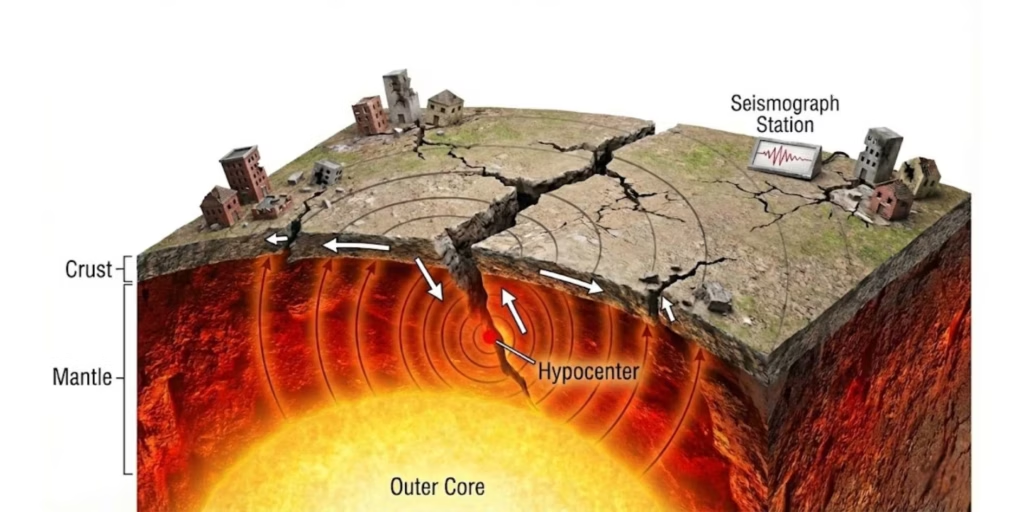
Now picture Earth like a giant machine that looks calm on the outside but never stops working on the inside6. The outer shell is made of huge pieces called tectonic plates7. These plates float on a deeper layer that moves slowly because of the heat rising from inside the planet8. Hot material rises then cools and sinks again forming slow currents that push the plates along9. The plates move only a few centimeters each year yet their edges are rough so they often get stuck10. When they try to move and cannot slide smoothly the force behind their motion does not vanish. It gathers inside the rocks like pressure building behind a jammed door11.
That pressure can sit there for years or even centuries12. It keeps growing until the rocks can no longer hold it. When the locked section finally snaps free all the stored energy bursts out at once13. That burst is the earthquake. The shaking you feel comes from waves of energy racing through the ground the same way ripples spread when you drop a stone into water14. Except these ripples move through solid rock which is why the ground vibrates so strongly15.
Most earthquakes happen where the plates meet16. Some plates crash into each other some pull apart and some slide past sideways17. Each motion builds stress and when that stress reaches its limit the Earth adjusts itself with an earthquake18. Small quakes happen every day yet most are too weak for us to feel19. Bigger ones strike when the rocks stay stuck for a long time and then release all that energy in a single powerful moment20.
When you see the whole process laid out earthquakes stop looking like random disasters. They become part of how the planet breathes and reshapes itself21. Without plate movements we would not have mountains rising or oceans opening or continents drifting into their familiar shapes22. Earthquakes are simply the planet keeping itself alive and in motion23.
Is It Possible to Prevent Earthquakes What Scientists Know
If you want to understand how to stop earthquakes, the first thing to see is that you are really asking how to stop the Earth from being the Earth. Picture the planet like a giant engine with heat trapped deep inside. That heat keeps the soft layer under the crust moving very slowly, the same way thick soup begins to swirl when it heats up. Those slow motions push the tectonic plates above them. Earthquakes happen when the plates try to move, get stuck, store energy, and then suddenly slip. So asking how to stop earthquakes is like asking how to stop the ocean from making waves or the wind from blowing. You would have to shut down the entire system that keeps the planet active.
To stop earthquakes completely, the plates would need to stop moving. For the plates to stop, Earth’s interior would have to cool so much that the circulation inside it freezes. But if that happened the planet would lose its heat, its magnetic field would fade away, volcanoes would die out, continents would stop forming, and life itself would struggle to survive. Earthquakes are not mistakes. They are proof that our planet is alive and always reshaping itself.
So can we stop earthquakes? No. But can we stop earthquakes from destroying our lives? Yes. We already create flexible buildings that bend safely, design early warning systems that sense tiny vibrations before the strong shaking arrives, and avoid building major cities on dangerous faults when we can. These steps do not stop earthquakes, but they stop earthquakes from turning into disasters. Some scientists imagine releasing pressure along faults in small amounts, yet the Earth is far too large and too complex for us to control. The stress is buried through hundreds of kilometers of solid rock under extreme pressure. No machine we can build today can manage that.
If you want to explore why the planet behaves this way and how it became so active, Cosmic Why will take you deeper into Earth’s origins and the forces that shaped it into the dynamic world we live on today.
Anchorage Shaken by 6.0 Alaska Earthquake Here Is the Real Impact
The Thanksgiving earthquake in Southcentral Alaska, a magnitude 6.0 tremor, sent strong shaking through Anchorage and nearby areas yet left no major damage or injuries behind. Early checks from emergency teams and local authorities showed that roads, bridges, airports, and public infrastructure stayed solid. The quake’s depth, nearly 70 kilometers underground, softened the impact before it reached the surface. People felt shelves rattle, homes sway, and a sharp jolt that woke many out of rest, but no structural failures or serious losses have shown up so far. Aftershocks may still occur and small household damage might appear as people look closer, yet the overall effect remains limited. There is no tsunami risk and daily life across the region has already returned to normal.
Insight Notes
- Alaska experiences some of the strongest earthquakes in the United States because it sits on the boundary where the Pacific Plate pushes under the North American Plate.
- Even moderate quakes in Alaska are common since the crust is constantly under pressure from ongoing tectonic movement.
- Seismic waves from shallow quakes travel quickly and create strong shaking that people feel instantly.
- Sudden quakes often trigger a mix of confusion fear and instinctive reactions even when structural damage is limited.
- Alaska’s frequent quakes shape emergency planning public awareness and building codes which help reduce damage during larger events.
- The interior of Earth stays active because radioactive elements and leftover heat from the planet’s formation keep generating internal energy.
- Earth’s lithosphere is broken into major and minor plates such as the Pacific Plate the North American Plate and the Eurasian Plate.
- This deeper layer is the asthenosphere a semi solid region that behaves like thick putty over long time periods.
- These currents are known as mantle convection currents and they are the main driver of plate motion.
- Plate boundaries contain rugged rock formations and faults that catch the plates and prevent smooth movement.
- This buildup of energy is called elastic strain energy which stores in rocks until it breaks free.
- Some faults store stress for hundreds of years before producing major earthquakes such as the Cascadia Subduction Zone.
- The sudden release creates seismic waves which spread outward from the rupture point.
- These are primary waves secondary waves and surface waves each causing different types of shaking.
- Seismic waves can travel thousands of kilometers through Earth’s crust mantle and core depending on their type.
- Plate boundaries such as subduction zones and transform faults host the majority of global seismic activity.
- These motions create convergent divergent and transform boundaries each producing different fault types.
- This natural adjustment process is part of the global tectonic cycle which constantly renews and reshapes Earth’s crust.
- Worldwide seismometers detect thousands of microearthquakes daily although humans notice only stronger ones.
- Large quakes occur after long periods of fault locking during which massive strain accumulates.
- Tectonic activity is essential for recycling Earth’s crust regulating temperature and shaping the surface.
- The Himalayas the Atlantic Ocean and even the Pacific Ring of Fire all exist because of plate tectonics.
- Earth is geologically active which keeps it dynamic unlike planets such as Mars or Mercury which have cooled and become mostly inactive.


