
In the quiet flow of 2025, the Sun suddenly broke the pattern. It threw powerful flares into space and sent them racing toward Earth. Radio networks crackled, GPS signals wobbled, flights slowed down or changed their routes, and auroras showed up in places that had never seen them before. The sky looked magical yet the impact was real. Our world full of satellites and smartphones still bends to the moods of a star that can change our day with one sudden flash.
Know Your Sun

But have you ever stopped to think about how this distant object in space shaped every part of our story. It helped life bloom on Earth, guided evolution, and even filled our energy reserves long before we learned how to tap them. Yet the same Sun that keeps us alive also holds a force strong enough to shake our planet. That force is the solar flare. And now we are going to explore what that really means.
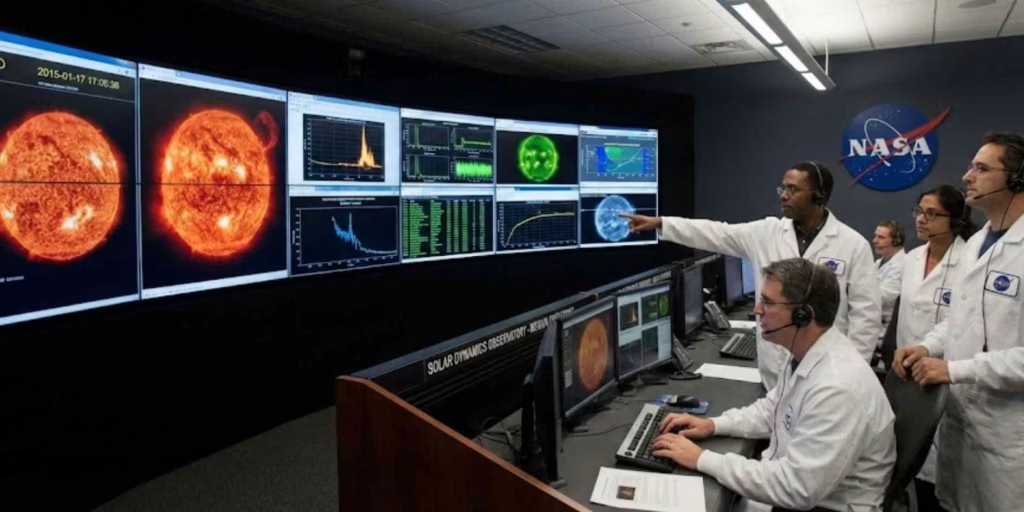
What Exactly Is a Solar Flare
If you want to understand solar flares in a real way, you first need to understand the Sun itself, and that is exactly what your codex Know Your Sun helps you do. It shows how the Sun works from the inside out so flares stop feeling like strange surprises and start feeling like the natural heartbeat of a living star. Think of this explanation as a small preview of that experience.
The Sun is made of plasma a hot soup of charged particles1. Since these particles carry electric charge they build and follow magnetic fields on their own2. The Sun’s surface never rests. It boils and swirls and stretches every second3. Its equator spins faster than its poles and the outer layers churn like boiling water that never cools4. This uneven motion twists the magnetic field lines the same way twisting a rope stores tension5. As the magnetic loops get more tangled they grow unstable. That is when sunspots appear6. These are places where the magnetic field is strongest and the tension is at its peak7.
A solar flare erupts when the twisted magnetic field lines suddenly snap into a simpler shape8. In that instant the stored magnetic energy releases into the surrounding plasma9. The gas heats to millions of degrees in just a few seconds and sends out radiation that ranges from radio waves to strong X rays10. A simple way to see it is to imagine stretching a rubber band until it cannot take any more and then letting it go. The Sun does this on a massive scale and the result is a flash so sharp and bright that we can detect it from millions of kilometers away11.
Sometimes these flares trigger something even larger called a coronal mass ejection12. It is a giant bubble of plasma and magnetic field thrown into space13. When this blast heads toward Earth it can shake our magnetic field create brilliant auroras disrupt radio links confuse GPS readings and put extra pressure on satellites and power grids14. The flare happens on the Sun yet its shockwaves reach into our daily life because almost everything we depend on runs on electricity and clean signals15.
What makes solar flares so interesting is that they are not random blasts16.
If this sparks your curiosity and you want to understand the Sun in a clear simple and natural way Know Your Sun is the perfect next step17.
Can Solar Flares Destroy Earth The Real Science Explained
The Sun is a giant sphere of plasma that never stops moving. Its swirling layers twist and store magnetic energy. When that tension grows too high, it snaps and releases as a solar flare. Most flares are mild. Earth’s magnetic field and atmosphere block the worst of the radiation, so the damage stays limited to signal drops, satellite errors, or short disruptions in technology.

The true danger appears when the Sun creates something far beyond an ordinary flare18. Stars like ours can unleash superflares blasts thousands of times stronger than anything modern science has recorded19. If a superflare aimed directly at Earth the radiation and charged particles would punch through our magnetic shield20. Satellites would fail almost instantly as their electronics burn from the sudden surge21. Every system that depends on those satellites would vanish too. Navigation aviation routes internet backbones banking signals weather tracking everything would flicker out in seconds22.
A superflare would also force a massive electrical current into Earth’s crust23. Power grids across continents would collapse under the overload24. Transformers would melt25. Restoring electricity would take months or years not days. Without power water systems would stop hospitals would run on empty backup fuel transportation networks would freeze and emergency services would break under the strain26. It would not be a simple blackout. It would be a deep global shock to our entire technological world27.
In the most extreme cases the flare could strip parts of the upper atmosphere letting ultraviolet and high energy particles reach the surface28. Radiation levels could rise enough to harm crops damage living cells and weaken entire ecosystems29. Earth would stay physically whole but its protective layers would thin exposing life to dangerous conditions30.
This scenario is not science fiction. It is a natural extension of what the Sun already does31. Solar flares are not random blasts. They are the Sun rearranging itself when magnetic energy becomes too much to hold32. Under the right conditions the same process that makes a small flare can create a world changing one33. To grasp this fully you need to see how the Sun works why it stores energy and how it releases it.
The codex Know Your Sun dives deep into these inner mechanics34. It shows how the Sun’s physics shape everything from warm sunlight to planet shaking outbursts35. If you want the full picture of our star’s power and its impact on Earth it is the perfect next step36.
Insight Notes
- Plasma is the fourth state of matter where electrons break free from atoms creating a mix of charged particles that respond to magnetic fields.
- Moving charged particles naturally create magnetic fields and become trapped in the Sun’s magnetic loops.
- This motion comes from convection currents in the outer layers where hot plasma rises and cooler plasma sinks.
- This difference in rotation speed is called differential rotation and it twists magnetic field lines.
- The twisting increases magnetic stress which builds energy inside the loops.
- Sunspots form where magnetic fields rise through the surface blocking heat and creating cooler darker patches.
- Sunspot regions can store enough magnetic energy to power large solar flares and eruptions.
- This process is called magnetic reconnection and it rapidly converts magnetic energy into heat and motion.
- The released energy accelerates particles and produces intense radiation bursts.
- Major solar flares can reach tens of millions of degrees and produce X ray flashes detectable from Earth orbit.
- Space telescopes such as GOES and SDO monitor these flares in real time from Earth’s orbit.
- A coronal mass ejection or CME is a huge cloud of plasma and magnetic field released from the solar corona.
- CMEs can carry billions of tons of material traveling at millions of kilometers per hour.
- Strong CMEs can cause geomagnetic storms like the 1989 Quebec blackout and the famous 1859 Carrington Event.
- Modern communication navigation and power infrastructure are sensitive to space weather disturbances.
- Flares follow the solar magnetic cycle which rises and falls approximately every eleven years.
- Know Your Sun explains the Sun’s layers behavior and energy in a simple structured way for any reader.
- Ordinary solar flares release energy equivalent to millions of nuclear bombs but superflares can exceed this by thousands of times.
- Superflares have been observed on Sun like stars by telescopes such as Kepler though none that strong have occurred on our Sun in recorded history.
- A strong enough flare can compress Earth’s magnetosphere allowing more solar radiation into the upper atmosphere.
- High energy particles cause single event upsets and radiation damage that can destroy satellite circuitry.
- GPS communication satellites weather monitoring and timing systems all rely on sensitive electronics vulnerable to solar storms.
- Solar storms induce geomagnetically induced currents or GICs which flow through the ground and enter power grids.
- Long transmission lines act as antennas for these currents overwhelming grid infrastructure.
- High currents can overheat and permanently damage large power transformers which take months to replace.
- Modern infrastructure relies on stable electrical power for pumping systems medical equipment communication and transport.
- A continent scale grid failure would disrupt supply chains communication and governance creating long term instability.
- Intense solar radiation can erode the ionosphere and thermosphere reducing atmospheric protection.
- Increased radiation can disrupt photosynthesis DNA integrity and ecological stability.
- The atmosphere acts as a natural shield blocking harmful solar and cosmic radiation.
- Historical events like the Carrington Event of 1859 show that large solar storms are real and potentially devastating.
- Magnetic reconnection is the physical trigger behind all solar flares and eruptions.
- The scale of a flare depends on how much magnetic energy builds up in sunspot regions before release.
- Know Your Sun explains the Sun’s structure magnetic behavior and solar cycle using simple accessible language.
- Solar radiation solar wind and magnetic activity all influence Earth’s climate space weather and technology.
- The codex connects solar science with real world impacts making the Sun easier to understand for any reader.


