
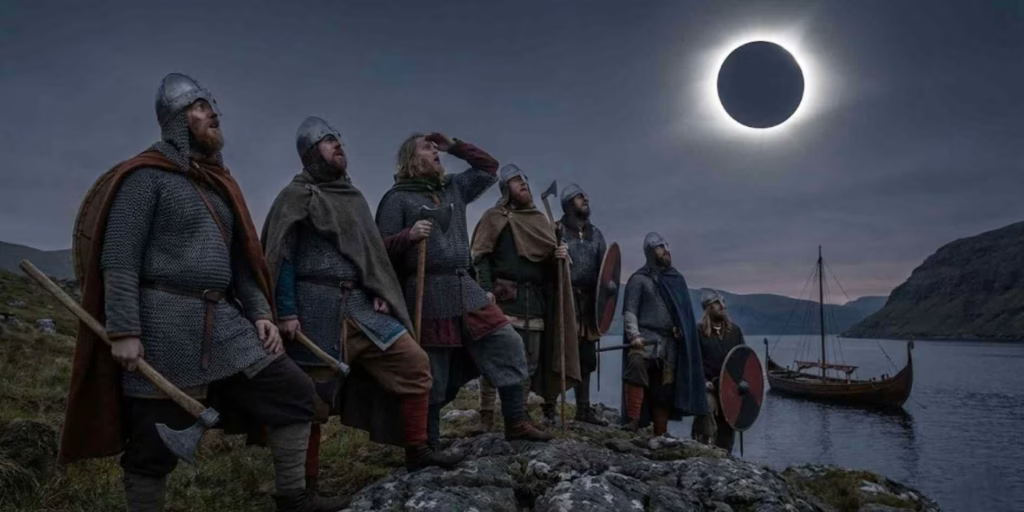
Ancient Vikings believed a solar eclipse began when the sky wolves Skoll and Hati chased and tried to swallow the Sun. That old story sets the stage for our next question which is how humans moved from myths like this to careful study and scientific tracking of eclipses over time.
Step Inside the Old Norse World


How Humans Studied Solar Eclipses: Ancient Methods to Modern Technology
1. Early Curiosity
The first humans who watched the Sun vanish had no instruments and no language of science. They relied only on their senses. The sky went dark. The air turned cold. Shadows twisted in strange shapes. Animals grew quiet. From these raw moments they tried to understand what was happening. They watched the sky again and again. They noticed the Moon lingering before some eclipses. They marked stones and the ground to follow where shadows fell. Slowly they learned that the Sun’s disappearance was not random. It followed a rhythm. Every new insight came from breaking the event into simple pieces, light darkness and motion, and building meaning from those pieces.
2. Viking Beliefs
Vikings explained eclipses with the tale of Skoll and Hati, two sky wolves chasing the Sun and Moon. It was myth, yet it created a structure people could use. When the sky dimmed, they stayed alert and warned their villages. They remembered each eclipse because it felt like a sign. This memory mattered. Without writing systems, stories became the tool that carried observations across generations. The myth turned a frightening moment into something people expected and helped them notice that the darkening of the sky followed patterns deeper than fear.
3. Ancient Tracking
As civilizations grew, they needed precision. Farmers needed planting dates. Armies needed timing. Priests needed reliable calendars. So they recorded every eclipse. Over centuries those records revealed repeating cycles. The Babylonians discovered a pattern of about eighteen years, now called the Saros cycle. They knew nothing about orbital mechanics. They simply broke the eclipse into measurable parts duration, shadow size, season, Moon position and compared them. From patience and pattern seeking they learned that nature moves with steady rhythm, a rhythm that can be written, measured and predicted.
4. Rise of Mathematics
When Greek astronomers turned their eyes to eclipses, they used logic and geometry. They asked what shapes and motions could cause the Sun to disappear. They measured angles and shadow lengths and used these numbers to estimate Earth’s size, the Moon’s size and the distances between them. They realized eclipses happen when three bodies line up. This clarity came from reducing the event to pure motion and shape. No myth. No guesswork. Only measurable relationships. They turned the eclipse into a problem that could be solved, shifting human thinking from fear toward understanding.
5. Telescopic Discovery
The telescope changed everything. For the first time humans could see what their eyes alone could never catch. They saw the Sun’s corona, its flares, its looping prominences. Scientists measured changes in light second by second and saw the Sun as a physical object with layers and structure. Eclipses were no longer mysterious. They were shadows cast by two celestial bodies in motion. By breaking the event into visible features, scientists learned about the Sun’s atmosphere and even discovered elements inside it. Observation stepped out of storytelling and stepped into physics.
6. Modern Technology
Today we study eclipses with satellites orbiting Earth and spacecraft flying close to the Sun. Instruments measure magnetic fields, plasma streams, radiation and solar winds. Computers can predict eclipses centuries in advance with astonishing accuracy. Scientists no longer rely only on watching the sky darken. They track data from sensors far from Earth, sometimes billions of kilometers away. By isolating each part of the eclipse shadow path, timing, energy flow and solar activity they build a full picture of why eclipses happen and what they reveal about the Sun.
7. The Journey
The path from Viking sky wolves to modern satellites follows one deep human habit. When something extraordinary happens, people first watch, then question, then test and finally understand. Each generation broke the eclipse into smaller pieces and rebuilt the explanation with sharper clarity. That long journey turned a sudden darkening of the sky into one of the most predictable and scientifically rich events known to astronomy.
How Vikings Created Their Solar Eclipse Myth
To see how Vikings shaped their eclipse myth you need to start with what they actually lived through1. Their sky changed in dramatic ways. Long bright summers. Long dark winters2. Auroras moving across the night3. Sudden storms at sea4. And sometimes without warning the Sun began to fade in the middle of the day5. They had no science to explain orbits or shadows6. They worked with the tools they knew best: daily experience familiar animals and a worldview built on battles between order and chaos7.
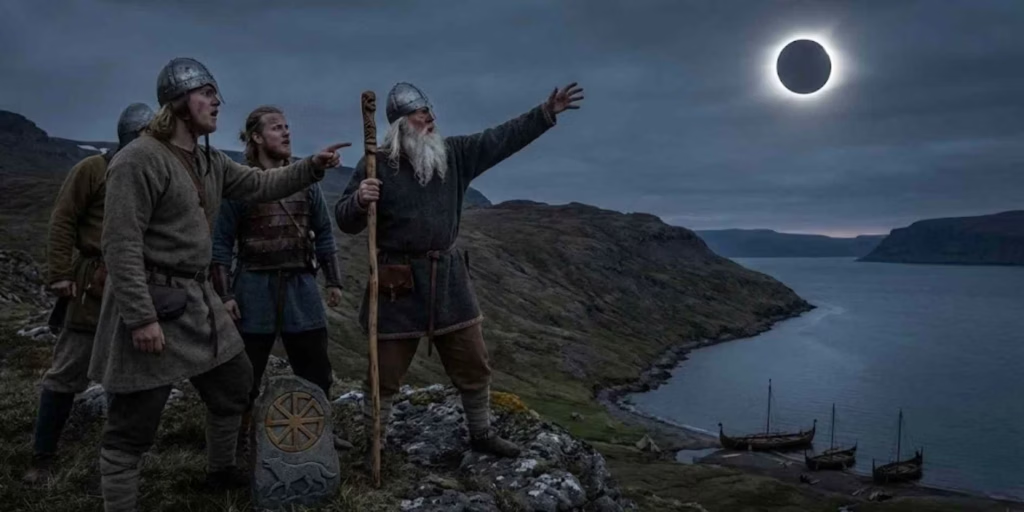
In that world the Sun and Moon were not objects. They were living beings. Norse poems describe Sól and Máni driving chariots across the sky. That picture already turns the sky into a road. And on any road there can be hunters. Wolves were the natural choice. They were feared, they chased prey for long distances, and their howls shaped northern nights. From this mix came Skoll and Hati, the sky wolves who raced after the chariots of Sól and Máni.
Now imagine an eclipse with no warning. The light thins. The air cools. The Sun looks as if something is biting into it from one side. To a Viking eye, that shape makes perfect sense. It looks like a mouth closing over a glowing target. So the idea that wolves were catching the Sun was not random poetry. It was a direct, instinctive reading of what the eye saw in the sky.
The Viking world already expected a final disaster Ragnarök when monsters and gods would collide and the world would burn8. Old sources say that during those final days the wolves would devour the Sun and Moon9. Once that prophecy existed any sudden dimming of the sky could feel like a warning10. Some later traditions describe people banging shields and shouting to scare the wolves away11. These rituals turned fear into action and made people feel less helpless when the sky darkened12.
There is another layer. The daily chase of Skoll and Hati explains ordinary life too13. One wolf hunts the Sun and the other hunts the Moon. As long as they fail to catch them day and night continue as usual. Only when the chase succeeds do we get an eclipse or the final darkness14. You need to see how a single story could explain both the everyday rhythm and the rare shock. That is what made the myth powerful15.
Modern scholars note that the oldest Norse texts never say plainly that this myth explains eclipses16. But they do describe wolves chasing and eventually devouring the Sun and Moon and later traditions link that to solar and lunar darkening17. The logic is simple. People saw the Sun being eaten piece by piece remembered the old tale and shaped their stories around the moment18. Over time the explanation settled into tradition19.
Put all of this together and the myth grows naturally. The Sun and Moon feel alive. Wolves are perfect hunters. An eclipse looks like a bite. The culture expects a final catastrophe. Those pieces merge into Skoll and Hati the wolves whose endless chase turned a frightening cosmic event into a story people could remember retell and use every time the light began to disappear20.
Insight Notes
- Norse societies relied on oral tradition not scientific astronomy to interpret unusual sky events.
- Scandinavia experiences extreme seasonal daylight shifts due to its high latitude.
- Auroras are common near the Arctic Circle and were frequently observed by Norse people.
- The North Atlantic is known for fast forming violent storms which shaped Viking seafaring culture.
- Solar eclipses were unpredictable for ancient cultures and often seen as supernatural threats.
- Accurate eclipse prediction only became possible after mathematical astronomy developed centuries later.
- Norse mythology often framed natural events as conflicts between cosmic forces such as gods and giants.
- Ragnarök appears in sources like the Poetic Edda and Prose Edda describing the destruction and rebirth of the world.
- Texts describe Skoll and Hati consuming the Sun and Moon at the end of time.
- Pre scientific societies often interpreted eclipses as omens linked to mythic predictions.
- Medieval Scandinavian folklore includes descriptions of loud rituals performed during eclipses.
- Rituals helped communities cope with unpredictable natural events using shared behavior.
- In Norse myth Skoll chases the Sun and Hati chases the Moon creating the cycle of day and night.
- Eclipses fit naturally into the idea of the wolves briefly catching their prey.
- Myths that explain both common and rare events tend to persist strongly in oral cultures.
- The Eddas do not directly mention eclipses though later folklore links the myths to them.
- Post Viking era sources associate Skoll and Hati with eclipse events.
- Visual similarity between an eclipse and a bite reinforced the mythic connection.
- Oral storytelling stabilizes when repeated across generations.
- The Skoll and Hati myth reflects a blend of cosmology fear and cultural storytelling shaped over centuries.