This is the era where we demand rigorous proofs problem statements and clear explanations for why everything happens. We want evidence for every claim and we expect science to answer every question. But there was a time when the world did not draw such sharp lines. An era where mysticism and science lived side by side often blending into one another. In that world religion shaped the way people understood nature just as it still does today but back then its influence reached much deeper into everyday thought.
Step Inside the Old Norse World


When Science Was Magic
To understand how deeply that era mixed belief with observation we have to look at the strange moments people truly accepted as real. Many such stories exist but in this blog I will focus on the bizarre incidents that people not only witnessed but genuinely believed in.
The Philosopher’s Stone and the Pursuit of Immortality
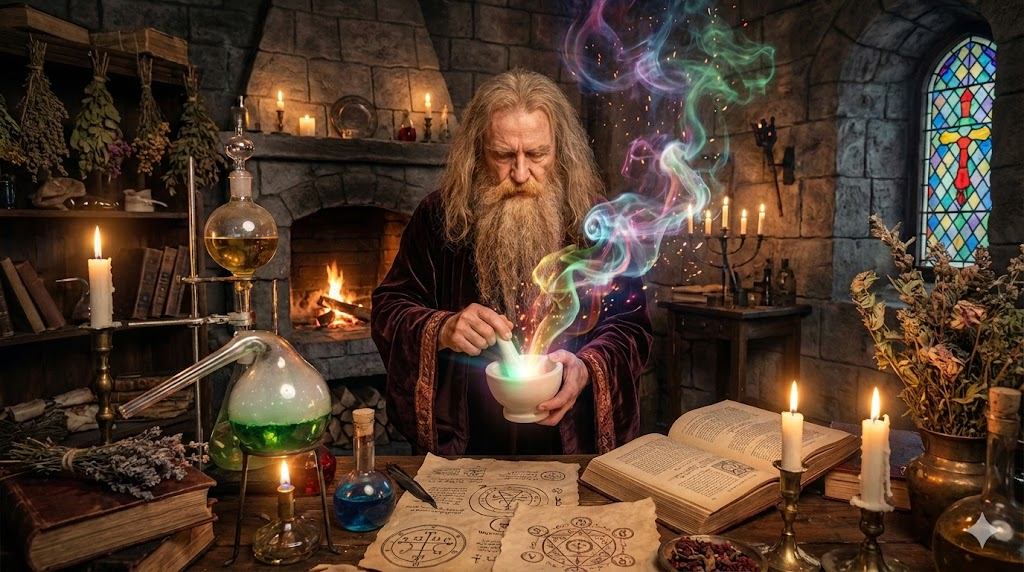
In the medieval world science did not look like science. It looked like wonder. It looked like secrets written in symbols only a few could read1. It looked like fire glowing under glass while alchemists whispered old formulas hoping the universe would reveal one more hidden truth2. The greatest dream among them was the Philosopher’s Stone3. This single legendary substance promised everything humans feared losing or wished to gain. It could turn common metals into gold and it could heal the sick or even grant immortality4. In a time when matter and spirit were believed to be woven together this did not feel impossible5. To the alchemists it felt like learning the language of creation itself6.
Their workshops became places where mysticism and early experimentation lived side by side7. They hid their writings in coded symbols so only the worthy could understand them8. They believed the universe worked through deep connections between planets metals colors and virtues9. Lead belonged to Saturn. Gold belonged to the Sun10. Changing one into the other was not just chemistry. It was a spiritual ascent11. As they purified the metal they believed they purified themselves12.
Some figures rose into legend and their names still glow inside this mystical tradition. Hermes Trismegistus became the mythical father of alchemy a figure said to hold a “Hermetic wisdom” that bridged heaven and earth13. His teachings shaped the belief that all matter could transform once someone understood the hidden laws of nature14. Centuries later the stories of Nicholas Flamel spread across Europe15.
People claimed he discovered the Stone and lived far beyond a normal lifetime16. Even though most of his tale is myth Flamel became the symbol of every alchemist’s hope that the impossible might be just one secret recipe away17.
Isaac Newton: The Genius Who Believed in Alchemy
Can you believe that one of the hardest working and most brilliant scientists in history also fell into these ideas18. And this was not a small thing because Newton was the man who built the foundation of the physics we rely on today19.
It often surprises people that the same mind that discovered gravity and shaped modern science was also deeply involved in the mystical world of alchemy20. Newton never treated alchemy as fantasy. He wrote more than a million words on it filling notebooks with experiments coded recipes and interpretations of ancient texts21. For him alchemy was not separate from science. It was another path to the hidden laws of nature22. He believed matter could transform that metals carried spiritual meaning and that ancient wisdom stored clues about creation itself23.
Newton searched for the Philosopher’s Stone with the same intensity he brought to calculus and optics24.
How “Magical” Experiments Created the Scientific Method
For medieval alchemists the goals were often fantastical. They searched for eternal life for the Philosopher’s Stone and for a way to turn lead into gold25. Yet even though their dreams were shaped by mysticism their methods quietly transformed the world26. In dim workshops lit by oil lamps these “magicians” became the first real experimenters27.
They heated distilled purified mixed and wrote down every success and failure with an intensity no one before them had attempted28. They believed nature hid its secrets behind layers of symbol and matter and the only way to uncover those secrets was through repeated trials29.
That mindset laid the foundation for the scientific method long before anyone named it30.
Their notebooks show systematic observation careful measurement and step by step documentation31. They chased magic but created the rules modern science still follows32.
Many tools and techniques that fill laboratories today were born in their alchemical chambers33. The alembic pot a simple but brilliant distillation device let them separate and purify liquids and became the ancestor of countless modern instruments34.
Aqua regia the fierce acid mixture capable of dissolving gold came from their search for deeper reactions between metals and acids35. Alcohol distillation also began as part of their quest for purified essences they believed carried spiritual strength36. Over time these techniques moved from mystical aims to practical chemistry medicine and industry37.
Alchemists did not find immortality or create gold but they built the toolkit that let scientists understand matter with clarity instead of myth38.

Insight Notes
- Alchemy used coded diagrams ciphers and symbolic language that only initiated practitioners were trained to interpret.
- Alchemical experiments often involved heating metals acids and minerals inside glassware to observe mysterious transformations.
- The Philosopher’s Stone was believed to be a substance that could perfect metals and extend life through the Elixir of Life.
- The Stone’s supposed power included transmutation and producing the Elixir which was said to restore youth and health.
- Medieval natural philosophy viewed physical and spiritual change as interconnected making magical transformation seem plausible.
- Alchemy framed the universe as governed by hidden laws that could be unlocked through symbolic and experimental mastery.
- Alchemy blended ritual practice with hands on experimentation forming a bridge between magic and early chemistry.
- Alchemists used secrecy to protect knowledge and prevent misuse by the uninitiated or untrained.
- Classical astrology linked each metal to a celestial body which shaped alchemical theories of transformation.
- The traditional planetary metal associations connected Saturn with lead and the Sun with gold based on symbolic qualities.
- Alchemical transmutation was seen as both physical change and inner purification of the practitioner.
- The alchemist’s moral refinement was considered essential to achieving successful transformation.
- Hermes Trismegistus is a syncretic figure combining elements of the Greek god Hermes and the Egyptian god Thoth credited with foundational Hermetic writings.
- Hermetic philosophy emphasized unity of the cosmos and the possibility of transformation through knowledge of natural law.
- Flamel was a fourteenth century French scribe whose later legend claimed he achieved the Philosopher’s Stone.
- The legend said Flamel and his wife achieved immortality after mastering the alchemical recipe.
- Flamel’s enduring myth reflects the timeless desire for mastery over nature through hidden knowledge.
- Many leading thinkers of the seventeenth century studied alchemy because it was seen as a serious attempt to understand matter.
- Newton’s laws of motion and universal gravitation shaped classical physics and remain fundamental to science and engineering.
- Newton spent decades studying alchemical texts believing they contained insights into the structure of matter.
- Historians estimate Newton produced over one million words of alchemical research which survived in manuscripts and private papers.
- Newton saw alchemy as a form of natural philosophy capable of revealing fundamental forces and transformations.
- Newton considered alchemical texts sources of symbolic truths pointing toward deeper physical principles.
- His alchemical work was driven by the same determination that produced his breakthroughs in mathematics and light.
- Alchemy promised transmutation and the Elixir of Life which were believed to grant wealth and long life.
- Alchemy mixed symbolic beliefs with practical experiments that eventually influenced early chemistry.
- Alchemists used furnaces glassware minerals and metals in experiments centuries before modern laboratories existed.
- Alchemists created some of the earliest systematic laboratory records detailing procedures and outcomes.
- Their belief in hidden patterns pushed them to perform trial based experimentation instead of relying only on philosophy.
- The cycle of hypothesis experiment and record keeping began in alchemical practice before it evolved into formal science.
- Surviving manuscripts reveal detailed procedures temperature notes ingredient lists and experimental diagrams.
- Reproducibility precision and controlled experimentation are rooted in alchemical traditions.
- Glass flasks retorts crucibles and distillation setups all originated in alchemical workshops.
- The alembic is the historical precursor to modern distillation columns stills and condensers.
- Aqua regia is made by combining nitric acid and hydrochloric acid producing a reagent strong enough to dissolve noble metals.
- Early alchemists distilled fermented mixtures to obtain ethanol first for medicinal and ritual purposes.
- By the Renaissance distillation metallurgy and acid work became essential parts of scientific laboratories.
- Alchemical knowledge paved the way for modern chemistry which replaced symbolic interpretations with atomic theory and measurable laws.

