
Indian Expedition
Alexander became the Great after conquering the Persian Empire. The entire might of the greatest empire was now kneeling to him, and Darius died, and that was it. Alexander thought this was where his competition ended, but that wasn’t it. By this time, Alexander had already conquered a significant land. Greece and Asia were now in his hands. Then he was not just a human king anymore. He became the god.
Egypt surrendered to him just by witnessing his conqueror aura, and they made him the Pharaoh. This settled the things for the new domain of Alexander the Great.

To understand how Alexander reached India, how he began his conquest there, and why he was unable to conquer the Indian subcontinent as he did the Persian Empire, you can read Fall of the Titans by Mundus Gnosis, and you will find all the answers there.
The Indian Conquest
If we try to judge Alexander and say that what was the need to begin the campaign in India and bring the doom upon himself, But imagine a man whose ambitions made him believe that he can achieve the impossible, and he then conquered the impossible in the form of Persian Empire. I won’t blame someone like him who did all he could just to make the things great for him.
And, also that wasn’t an impulsive decision from his side.
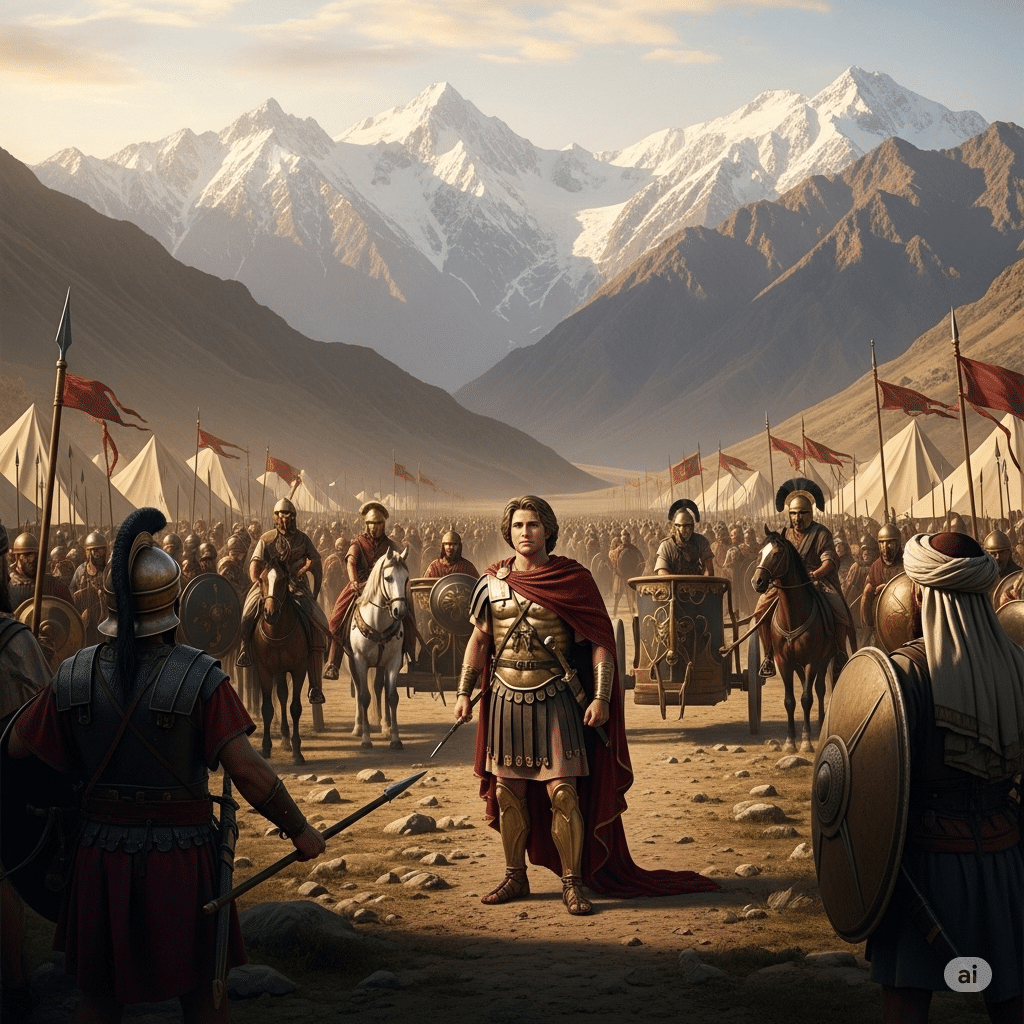
Alexander turned to the Indian subcontinent not out of impulse but because it was the next step in his broader strategy. After defeating the Persian Empire, the lands beyond the Hindu Kush were the last regions still outside his growing authority. He had already secured Bactria and Sogdiana, and to the east lay territories that had once paid tribute to the Persian kings. In Alexander’s thinking, they were part of the unfinished task he had inherited.
Local kings from the Indian Regions, once supported the Persian kings so that was a threat to his newly conquered empire. He had to prevent his lands from the threat and also, There was a large section of history from both Persian and Greek mentioned many things about the India and its culture.
In 327 BC, Alexander crossed the Hindu Kush and entered India through the Khyber Pass. The resistance he faced was immediate and determined. Tribes such as the Aspasioi and the Assakenoi defended their mountain territories with great resilience. These were not large imperial armies but local warriors who knew their land well, and each confrontation demanded patience and careful planning. Still, Alexander pressed forward.
Alexander’s Motivations for the Indian campaign
The lands beyond the Hindu Kush had once belonged to the wider Persian world and to Alexander that meant they were now part of his responsibility. But India was more than just a political objective. From his early years he had heard of it as a place marked on Greek maps not with certainty but with unanswered questions. It was said to lie at the edge of the world where unfamiliar rivers flowed and different peoples lived. These stories stayed with him not as myths to chase but as quiet possibilities a ruler might one day wish to see for himself.

There was also a sense of duty in his decision because Persian kings had once drawn wealth and tribute from Indian rulers. If Alexander truly intended to take the place of those kings then he would need to extend his authority into those eastern regions. He was not expecting instant wealth and he did not believe the campaign would be easy. He understood it would demand effort and caution and he prepared for that.
The campaign also reflected a steady curiosity rooted in observation and not in wonder. Alexander instructed his officers to document what they saw and he listened closely to local guides. He noted the flow of rivers and watched how the landscape changed. His journey was not only about extending rule but also about understanding the places that had remained distant in Greek knowledge.
So the Indian campaign did not begin with dreams of glory alone but with a sense of continuity. It was about completing the empire he had inherited and expanded. It was about reaching the lands that had once stood just beyond the familiar horizon. There was no rush to reach a dramatic edge of the world but rather a deliberate step forward taken with purpose and care.
Alexander’s Route into India Through the Hindu Kush
After securing the Persian Empire, Alexander did not turn back because he saw unfinished responsibilities to the east. The regions beyond Bactria had once paid tribute to Persian kings, and now they stood outside his control. To leave them would mean leaving a part of the empire vulnerable. His decision to continue was not dramatic, but it was practical and deliberate. Reaching these lands meant crossing the Hindu Kush, a mountain range that was steep, silent, and rarely passed by armies of his size.
Challenges Faced by Alexander While Crossing the Hindu Kush
The Hindu Kush did not offer a smooth path. Its terrain was narrow and steep, and its cold mountain winds made movement difficult. As the army climbed higher, the air became thinner and supplies became harder to carry. Horses lost footing and wagons broke down. There were no proper roads, and even the most experienced local guides could only do so much. Alexander had to reduce what the army carried and organize it carefully.
How Alexander Dealt with Tribes During His Indian Campaign
Once the army crossed the mountains, it entered valleys where independent tribes had lived for generations without outside rule. Tribes such as the Aspasioi and the Assakenoi resisted fiercely because they knew the terrain and had no interest in surrendering easily. These were not large organized armies but determined local defenders. Alexander chose to approach them with measured force. He offered terms when possible, but he did not hesitate when resistance continued. Each village required attention, and each battle needed care. These were not celebrated victories, but they were necessary ones that cleared the way forward.
How Alexander Set Up Supply Lines in His Indian Campaign
To avoid being isolated in unfamiliar territory, Alexander set up a chain of supply posts and garrisons behind his advancing army. These stations helped store food and secure communication. He placed trusted officers at key points so that the route remained open and stable.
These garrisons were not just for military presence but also served to build some local order and gather information.
Alexander’s Military Campaign in Punjab and the Battle of Hydaspes
After entering the Indian subcontinent, Alexander moved into Punjab, a region shaped by fertile land and wide rivers. His goal was not to conquer all of India but to bring the northwestern territories under control. This required more than just military strength because it involved dealing with local rulers, managing alliances, and choosing battles carefully.
How Alexander Formed Alliances with Indian Rulers Like Taxiles
One of the first significant encounters Alexander had in Punjab was with Taxiles, the ruler of a kingdom near the Hydaspes River. Taxiles chose diplomacy over resistance and offered his support to Alexander. This was partly because he had an ongoing rivalry with King Porus and saw Alexander as a useful ally. Alexander welcomed the cooperation and treated Taxiles with respect because he valued stability in these unfamiliar lands. Other smaller rulers either followed Taxiles’ example or were brought into line through short campaigns.
How Alexander Crossed the Hydaspes River to Surprise Porus
The Hydaspes River was swollen by monsoon rains, and its strong current made a direct crossing dangerous. On the other side, King Porus had already positioned his army and was prepared for any attempt. Alexander did not force the crossing immediately. Instead, he moved along the riverbank, making his plans less predictable. Then, during a stormy night, he led part of his army upstream and crossed at a quieter spot. The crossing was slow and difficult because the water was fast and the ground was uneven, but it was done in silence and with discipline. When morning came, Porus found Alexander already across and ready for battle.
What Happened in the Battle Between Alexander and King Porus
King Porus prepared his army with war elephants, cavalry, chariots, and infantry. The elephants were spread out across the field and created a wall that the Macedonian troops had never faced before. Alexander studied the formation and used a slow and steady approach. He sent cavalry to stretch Porus’ forces sideways while his main infantry line advanced with care.
The elephants created fear and confusion, but they were also hard to control in the chaos. Alexander’s men avoided them and aimed at the riders and the gaps between them. Over time, the pressure broke the structure of Porus’ army. Porus stayed in the fight and did not retreat, even after being wounded.
When the battle ended, Alexander met Porus and asked how he wished to be treated. Porus replied, “Like a king,” and Alexander honored that request. He allowed Porus to rule his own land and even granted him more territory.
Why Alexander Stopped at the Hyphasis River
After his victory at the Hydaspes, Alexander continued east because he believed there were still important regions left to secure. He moved through unfamiliar landscapes and brought more local territories under control. Eventually, he reached the banks of the Hyphasis River, now called the Beas. Beyond that point lay the vast plains of the Ganges, and it was here that his army came to a quiet but firm halt.
Did Alexander Plan to Invade the Ganges Region?
Alexander had received detailed reports about powerful kingdoms beyond the Hyphasis River. The land beyond was said to be rich with large cities and ruled by strong dynasties such as the Nandas. He intended to move toward the Ganges River because he believed that pushing further would complete his eastern expansion and secure the empire’s frontier. It was a strategic decision and not only a matter of ambition. He wanted to leave no space for future threats to grow in lands still outside his reach. However, even though the goal seemed necessary to him, his army no longer felt the same sense of urgency.
Why Alexander’s Army Refused to March Further
The soldiers had marched across continents for nearly eight years. They had faced deserts, mountains, rivers, and fierce battles. They had not seen their homes since the early campaigns against Persia. Now they stood in a land where the monsoon rains had begun, and the heat and unfamiliar climate wore them down even further.
They had also heard of eastern kingdoms that reportedly commanded large armies and thousands of war elephants. Whether these accounts were true or not, the uncertainty added to their concerns. The men were not disloyal, but they were exhausted and wanted to go home. Their refusal was not loud or violent, but it was united. They remained silent and firm, showing that their strength had reached its natural end.
How Alexander Reacted When His Army Refused to Continue
Alexander did not immediately accept their decision. He waited in his camp and hoped they might change their minds. He spoke to his officers and reminded them of all they had achieved together and of how close they were to finishing the journey. But their silence held. The army had given everything, and now they needed rest.
Eventually, Alexander agreed. He made sacrifices to the river and raised altars to mark the farthest point of his eastern march. This act was not driven by anger, but by understanding. He chose to turn back, not because he had been defeated, but because he saw the need to protect the unity and strength of the army that had brought him so far.
The Hyphasis River became a natural border, not only of his empire but also of the journey itself.
Other Blogs
No Posts Found


