
Life stays alive only when it finds energy. That is the simplest rule every organism follows. Plants use sunlight. Animals use food. Humans use everything from fire to electricity. Yet inside the ruined reactor at Chernobyl, scientists found something that refused to follow any of these rules. A dark fungus was not running from radiation. It was growing toward it. It used radiation the same way plants use light. This one discovery flips our basic idea of survival and opens a new window into how life might adapt in the most extreme places, from disaster zones on Earth to the deep unknown of space.
Explore the Mysteries of Time, Gravity, and the Universe


Chernobyl Disaster What Really Happened on April 26 1986
To understand what happened at Chernobyl, you need to start with the simplest truths. A nuclear reactor works only when two forces stay in balance. One force is the chain reaction that releases energy. The other is the control system that keeps that reaction steady. If the reaction grows faster than the control system can manage, the reactor turns unstable. That is the core idea behind every nuclear accident.
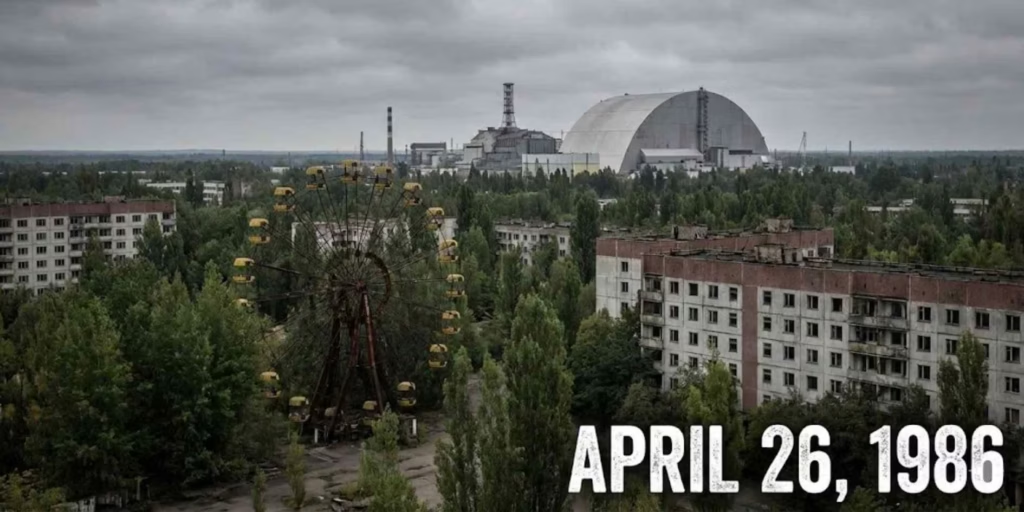
On April 26 1986 that balance collapsed inside Reactor Four of the Chernobyl power plant1. The operators were running a late night safety test to see how long the turbines could power the reactor during a blackout2. They slowed the reactor too much and then tried to bring it back up3. The design of the reactor hid a flaw that made it dangerously unstable at low power4. When the operators pushed it to rise again the reaction did not climb gently. It surged5. They pushed the control rods in to stop it but the tips had their own design flaw6. In the first instant of insertion they made the reaction jump even higher7. The power shot upward so fast that the fuel inside the core broke apart8. Steam blasted through the vessel9. A second explosion followed and tore the building open10.
With the core now exposed burning graphite and shattered fuel released a massive cloud of radioactive material into the air11. Firefighters arrived without knowing the danger they were walking into12. Smoke and dust carried radioactive particles across Ukraine Belarus and much of Europe13. All of this came from a single rule. When a system that depends on balance loses that balance even for a few seconds nature answers with its full force14.
Why Scientists Are Fascinated by the Chernobyl Fungus
Scientists are drawn to the Chernobyl fungus because it forces them to rethink what life can do at the edge of survival15. In a place filled with intense radiation where most organisms break down these dark fungi not only stay alive they often grow toward the most radioactive spots on the ruined reactor walls16. Many of them contain high levels of melanin the same pigment that darkens human skin17. In lab tests when this melanin sits under strong ionizing radiation the fungi grow faster and change the way they move electrons inside their cells18. This hints that the pigment is not just a shield. It may help the fungi tap radiation as a usable energy source almost like a rough version of how plants use light19.
That idea alone excites biologists because it expands the ways life can power itself20. But the fascination runs deeper. These fungi are living experiments in extreme adaptation21. They appeared in large numbers only a few years after the disaster and seem to have turned a deadly stress into part of their niche22.
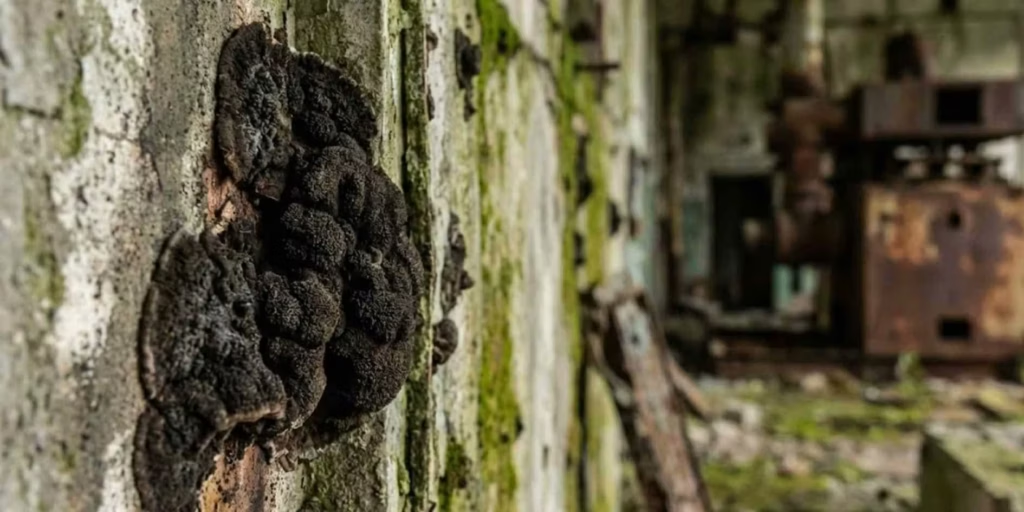
They give scientists a real time model for how organisms evolve in hostile environments and how melanin helps them handle radiation over long stretches of time. At the same moment, engineers and space researchers see something practical.
When a sample of Chernobyl fungus was grown on the International Space Station, even a thin layer slightly reduced the radiation beneath it. Models show that thicker fungal or melanin rich coatings could help shield future Mars habitats or spacecraft from cosmic rays.
Back on Earth, the same traits make these organisms valuable for cleaning or stabilizing radioactive sites.
A microbe that tolerates radiation, possibly uses part of it for energy, and forms dark protective films could support new approaches to bioremediation and long term containment at places like Chernobyl and Fukushima.
Insight Notes
- Reactor Four was an RBMK 1000 graphite moderated reactor used widely in the Soviet nuclear program.
- The test aimed to measure whether the reactor’s turbines could provide enough inertia to keep coolant pumps running until backup generators activated.
- Dropping to very low power created unstable reactor conditions because RBMK reactors become harder to control at low output.
- The RBMK design had a positive void coefficient meaning reduced coolant increased reactivity instead of lowering it.
- The rising reactivity triggered a runaway chain reaction far beyond safe limits.
- RBMK control rods had graphite tips that briefly increased reactivity when inserted into the core.
- The graphite displacement effect caused an immediate spike in power during rod insertion.
- The rapid energy spike fragmented the fuel assemblies and ruptured the channels.
- The intense heat instantly boiled coolant water creating explosive steam pressure.
- The second blast likely involved hydrogen and steam which destroyed the reactor hall roof.
- The exposed graphite fire lofted radioactive isotopes such as iodine 131 cesium 137 and strontium 90 into the atmosphere.
- First responders received lethal radiation doses because they had no protective gear or warnings.
- Atmospheric winds spread fallout across the continent with the heaviest contamination near Pripyat and Belarus.
- Complex systems like nuclear reactors rely on stable feedback loops and even brief instability can cause catastrophic failure.
- Extremophile organisms often thrive in conditions that are lethal to most life and provide insight into biological limits.
- Several strains including Cladosporium sphaerospermum were found growing toward radiation sources inside Reactor 4.
- Melanin is a complex polymer that absorbs electromagnetic radiation including ultraviolet and ionizing radiation.
- Studies show radiation enhances electron transfer processes in melanized fungi suggesting altered metabolic pathways.
- The phenomenon is called radiosynthesis where melanin may convert radiation into chemical energy similar to weak photosynthesis.
- If organisms can harvest ionizing radiation it widens the definition of habitable environments on Earth and other planets.
- Chernobyl fungi provide real time insight into rapid evolutionary responses under extreme stress.
- The sudden rise of melanized fungal colonies inside the reactor suggests they quickly exploited radiation rich conditions.


