
NASA Perseverance
People always pictured Mars as a silent, lifeless place, a world where nothing moves except dust sliding across empty ground. But when NASA’s Perseverance rover switched on its microphone, it heard something no one expected. It wasn’t silence; it was tiny crackles, little snaps of electricity hanging in the thin air. These weren’t the dramatic lightning bolts we see on Earth, but small sparks born from dust grains rubbing against each other inside Martian storms.
For the first time, we know the Martian atmosphere can make its own electricity, and that single fact reveals a planet far more active and mysterious than we ever imagined. It also leaves us with a thrilling question: if Mars can spark with electricity, what else is it hiding?
Want to Know More About Mars?

What Is the Perseverance Rover and Why Is It on Mars
The Perseverance rover began as an idea inside NASA soon after the Curiosity mission proved that Mars once had lakes, rivers, and the chemical conditions needed to support life1. The people who pushed this mission forward were leaders in NASA’s Mars Exploration Program and scientists at the Jet Propulsion Laboratory, especially the teams who built and operated Curiosity2. They realized that if Mars was once habitable, the next question had to be whether life actually existed there3. That thought became the blueprint for a new rover4.
NASA formally proposed the mission in 2012 during a science planning meeting, where the agency confirmed it would build a successor to Curiosity using the same successful design but with more advanced instruments. From that moment, engineers, planetary scientists, and mission planners at NASA and JPL began shaping the Mars 2020 mission into what we now know as Perseverance.
The need for this rover came from a scientific gap Curiosity couldn’t fill5. Curiosity showed that Mars had the right conditions for life yet it couldn’t confirm whether life ever existed6. Scientists wanted a rover that could search for biosignatures in ancient rocks detect organic compounds with greater precision and store samples for a future mission to return to Earth7. This goal became urgent because the best evidence of ancient life is likely locked inside sedimentary rocks formed in long gone lakes and river deltas8. Those environments once existed inside Jezero Crater which made it the perfect landing site9. If humanity wanted a real chance at finding evidence of life beyond Earth then a rover like Perseverance had to be built10.
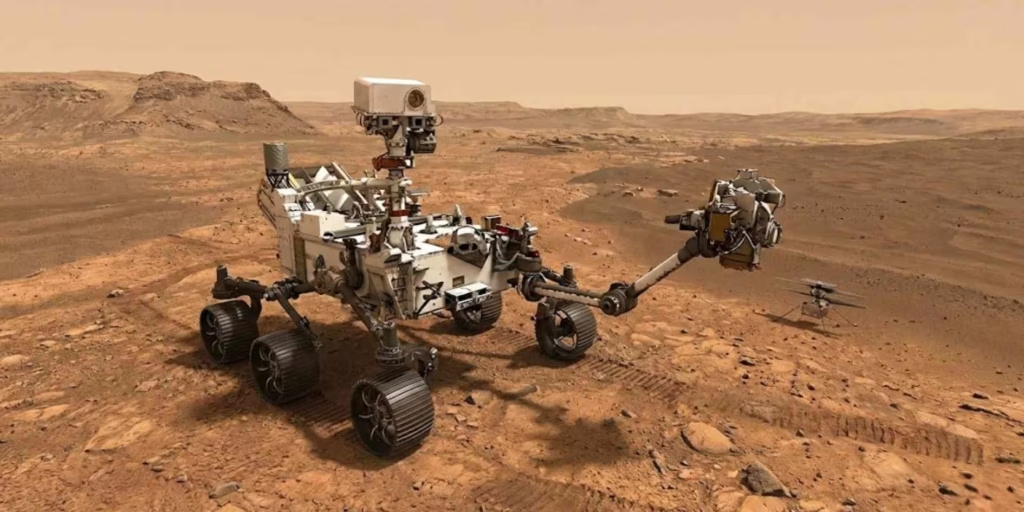
NASA supported this mission because it was the natural next step in exploring Mars and because the United States has long treated Mars research as both a scientific priority and a symbol of technological leadership. The mission also advanced long-term goals such as preparing for human expeditions, testing new technologies like the MOXIE oxygen generator, and demonstrating powered flight on another world through the Ingenuity helicopter. These experiments would help future astronauts create oxygen from the Martian atmosphere, navigate difficult terrain, and survive the planet’s harsh conditions.
Mars Is Not a Dead Planet: What Perseverance’s Latest Discoveries Prove
NASA’s Perseverance rover has made discoveries that naturally spark the kind of simple questions every curious mind asks. When the rover detected tiny lightning-like sparks inside Martian dust storms, it made scientists pause and wonder why a planet with such thin air could still create electric discharges. What does this reveal about Mars’s weather? And how might this affect the machines or astronauts we send in the future? This finding showed that Mars isn’t a silent, frozen world but a place with active forces still shaping its surface and sky.
The rover then explored ancient lakebeds and uncovered minerals and organic molecules locked inside old Martian rocks. These are the same kinds of minerals on Earth that form in water-rich environments where microbes can thrive. And that naturally leads us to ask what kind of world Mars used to be. Why did it have lakes and rivers? What changed it from a blue planet into a dry one? Could tiny forms of life have lived there when conditions were right? Perseverance can’t shout the answer, but it whispers enough clues to pull us deeper into the mystery.
It also found a metal-rich space rock that likely traveled from another part of the solar system before landing on Mars. That discovery raises new questions about how materials move between planets and what stories these wandering rocks can tell about the early solar system. Each finding becomes a doorway to more questions about where we came from and how many worlds might once have held life.
These discoveries matter because they push us closer to answering some of humanity’s oldest questions. Why are we here? What other planets once carried the ingredients of life? And when will we finally stand on Mars and explore it with our own eyes? If these questions excite you, then dive deeper into the truth of the Red Planet. Read Mars Exposed by Mundus Gnosis and uncover the hidden story of a world that still refuses to stop surprising us.
Insight Notes
- Curiosity discovered ancient lake beds, clay minerals, and past water flow patterns in Gale Crater, confirming long term water activity.
- The Mars Exploration Program is NASA’s long running strategy team that plans and manages missions to Mars while JPL designs and builds the rovers.
- NASA defines “habitability” as conditions where life could survive which naturally leads to searching for actual biosignatures.
- The search for ancient life became the core mission objective for Perseverance.
- Curiosity confirmed that Mars once had water and the chemical ingredients for life but its instruments were not designed to detect past microbial life directly.
- Curiosity’s tools could identify habitability but not conclusive biosignatures such as complex organic structures or microfossil patterns.
- Perseverance uses instruments like SHERLOC and PIXL plus a sample caching system that prepares cores for eventual return by the Mars Sample Return mission.
- Sedimentary rocks preserve fine layered structures and minerals that can trap biosignatures far better than volcanic or wind shaped rocks.
- Jezero Crater contains a preserved river delta rich in clays carbonates and hydrated minerals that indicate long standing water bodies.
- Astrobiologists consider Mars the most accessible place in the solar system to find signs of ancient extraterrestrial life.


